
Bangkok Interior Design Services: What Full-Service Delivers
Most people searching for Bangkok interior design services have already decided they need a professional studio. The real question is no longer whether to hire one, but what a serious studio should actually hand over — and where the hidden risks lie. This guide breaks down the deliverables, documentation, contracts and guarantees you should expect, so you can commission a project with confidence rather than crossed fingers.
1. Navigating Interior Design Services in Bangkok: Why Full-Service Matters
Bangkok is one of the most demanding cities in the region to renovate in. High-rise regulations, humidity, tight service-lift schedules and a fragmented contractor market mean that a beautiful 3D render is only the beginning. A full-service studio exists to close the gap between the design on screen and the space you finally live or work in.
1.1 The Complexity of Bangkok Real Estate & Renovation Risks
Premium condominiums, luxury residences and Grade-A office fit-outs each carry their own constraints. A single project can involve building-code compliance, juristic-person rules, imported materials with long lead times, and multiple trades working in sequence. When these are managed by the owner alone — or split across a designer and a separate contractor who never speak — the result is predictable: budget creep, schedule slippage and finishes that quietly drift away from what was approved.
The most common failure point in the interior Bangkok market is not bad taste; it is poor coordination. Materials get substituted for cheaper grades mid-build, joinery arrives a centimetre off, and no single party takes responsibility. A full-service model is designed specifically to remove those seams.
1.2 Defining the Full-Service Interior Design Model
A full-service (or turnkey) studio owns the entire journey: concept, detailed design, technical documentation, material procurement, in-house furniture production, on-site construction, quality control and final handover. Instead of hiring an interior designer in Bangkok for drawings and then chasing a contractor to execute them, you sign with one accountable team. That single point of responsibility is the core value of engaging a full-service interior design firm in Bangkok — one contract, one timeline, one quality standard.
2. Key Deliverables Across Project Phases
A professional studio structures its work into clear phases, each with defined deliverables you can review and approve before the next begins. This staged approach is what separates established bangkok interior design companies from operators who work loosely and improvise as they go.
2.1 Phase 1: Site Survey, Feasibility & Concept Layouts
Everything starts with an accurate site survey and measurement, paired with a feasibility review of the space. In Bangkok, studios typically charge in the region of 5,000–10,000 THB for this stage, depending on distance and area size. The first tangible deliverables are the layout plan — how the space will be organised and how people will move through it — and a mood and tone concept board that sets the visual direction together with the client. Approving these early prevents expensive changes later.
2.2 Phase 2: 3D Renderings & Material Selection Boards
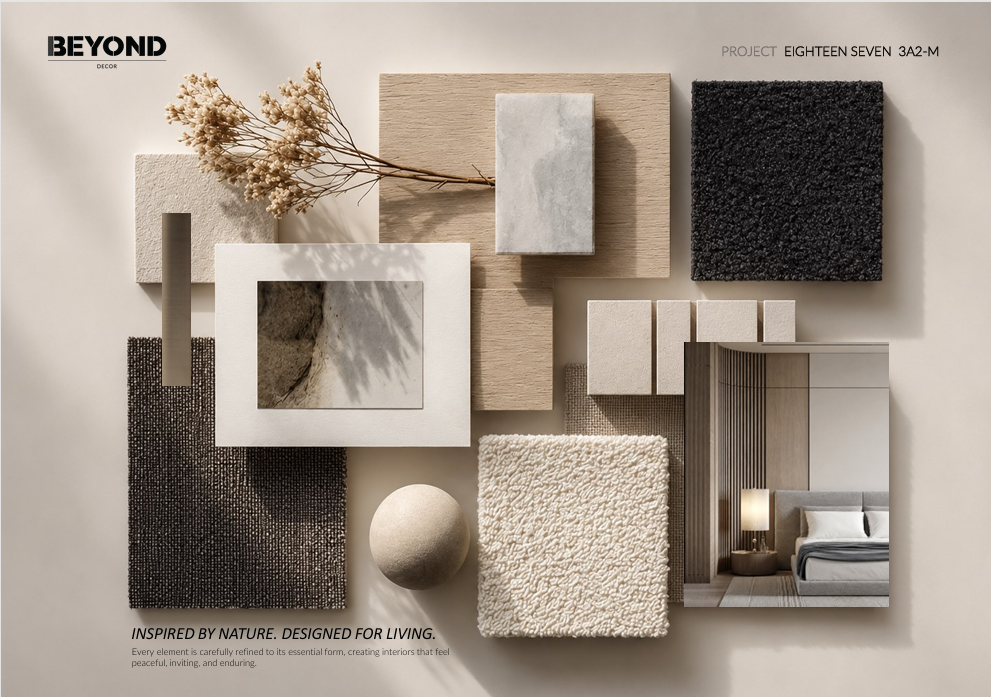
Once the layout is agreed, the studio produces detailed 3D perspectives (CGI) that show light, shadow and materials as they will appear in reality. A well-run studio defines the number of renders in the contract — for example, no more than five images per 60 square metres — so expectations are explicit. Alongside the visuals, you should receive physical material and finish samples: natural stone slabs, timber veneers, upholstery fabrics and metals. Seeing and touching real samples before anything is ordered is a safeguard that renders alone cannot provide.
2.3 Phase 3: Working Technical Drawings & Detailed Joinery Specs
This is where a design becomes buildable. The studio delivers a full set of technical working drawings, including electrical and lighting layouts, plumbing runs, ceiling detail drawings and joinery shop drawings for every piece of built-in furniture. These are accompanied by a Bill of Quantities (BOQ) that turns the design into a costed, approvable construction package. Without this level of documentation, a build relies on guesswork — and guesswork is where budgets break.
2.4 Phase 4: Factory Production, FF&E Procurement & On-Site Build
In a turnkey engagement, the studio moves into execution. Built-in furniture is produced in an in-house atelier, where the studio controls timber quality, joint precision and finishing rather than passing the work to unknown subcontractors. The team then handles construction, produce loose furniture and décor (FF&E — furniture, fixtures and equipment), and carries out a final inspection before handing over a space that is ready to use. This end-to-end control is the practical difference the best Bangkok interior design services offer.
3. Dissecting the Bill of Quantities (BOQ): The Shield Against Cost Overruns
If you read only one document carefully, make it the BOQ. It is the single most important instrument for controlling budget and construction quality, and the clearest signal of whether a studio works transparently.
3.1 The 9 Mandatory Construction Categories in a Professional BOQ
A professional BOQ itemises work across nine core categories: site preparation, structural work, built-in furniture, ceiling work, wall finishing, flooring, painting, electrical and lighting systems, and plumbing and sanitary systems. When a quotation collapses all of this into a few vague line items, you lose the ability to check, compare or clarify. A detailed nine-category breakdown lets you see exactly what you get.
3.2 Material Specifications, Quantities, and Labor Cost Transparency
Within each category, four elements protect you as the client:
| BOQ Element | What It Must Specify | Why It Protects You |
|---|---|---|
| Material Specifications | Brand, grade, size, colour code, country of origin | Prevents silent substitution of lower-grade materials during the build |
| Quantity & Standard Units | Square metres, linear metres, sets or square feet | Gives a fair basis for adding or reducing cost if specs change |
| Operation Overhead | Stated percentage for the company’s overhead and profit | Stops hidden charges being buried inside individual material prices |
A studio willing to expose its overhead and profit as a clear percentage is signalling confidence and honesty. That transparency is one of the strongest markers of a trustworthy interior design firm in Bangkok.
4. Design-Only vs. Turnkey Contracts: Choosing the Right Delivery Route
The contract structure you choose directly shapes your risk, personal involvement and your budget. Bangkok studios generally offer two routes.
4.1 Comparing Operational Friction, Risk, and Cost Transparency
Design-Only suits clients who already have their own trusted construction team. The studio delivers drawings, 3D visuals and the BOQ, charging a fee based on area. The trade-off is that you personally manage any conflict between the designer and the contractor, and you carry the risk if the built result drifts from budget or intent.
Turnkey (Design-Build) places design, factory production, construction and handover under a single contract. This closes communication gaps, protects against runaway costs and typically comes with a fixed price. For clients who value certainty over hands-on management, turnkey removes the friction that causes most renovation disputes.
4.2 Standard 5-Stage Installment Payment Breakdown
For turnkey work, Thai studios commonly split payment into four-five stages for transparency:
- Stage 1 — 50% on contract signing, to begin construction
- Stage 2 — 30% at roughly 30-40% progress, as built-in installation starts
- Stage 3 — 15% once furniture assembly and installation are complete, before delivery and installation of fit-in items
- Stage 4 — 5% on handover and signed acceptance of the space
A staged structure tied to visible progress keeps both sides accountable and gives you leverage until the work genuinely meets standard.
5. Contracts, Guarantees, and Juristic Person Compliance in Bangkok
Leading studios write their guarantees into the contract rather than leaving them to goodwill. These clauses are where local expertise becomes tangible.
5.1 Enforcing Late Penalty (0.1%/Day) and Material Protection Clauses
Three guarantees matter most. A schedule guarantee sets a late-delivery penalty — commonly 0.1% of the total contract value per day, capped at no more than 5% of the contract. A material substitution guarantee requires written client approval before any brand or grade is changed; if an unauthorised substitution is found, the studio must restore the original specification at no extra cost. A communication guarantee commits the studio to weekly progress reports with photographs and a response time of within 24-48 hours to client questions.
6. Conclusion: Checklist for Evaluating Bangkok Interior Design Companies
Before you commission any studio, run it against this short checklist:
- Does it deliver a staged, approvable set of deliverables — layout, mood board, 3D, technical drawings and BOQ?
- Is the BOQ itemised across all nine categories, with material specs, quantities, and overhead shown separately?
- Are guarantees written into the contract — schedule penalty, material protection and communication standards?
- Does it hold an in-house atelier for controlled built-in production?
- Does it clearly understand juristic-person compliance for high-rise work?
A studio that answers yes to all five is operating at the level a serious project deserves. If you are planning a residence, condominium or commercial space and want to see what full-service execution looks like in practice, book a consultation with the Beyond Decor team to walk through your space, scope and timeline.